-1.png?width=332&height=79&name=Untitled%20design%20(17)-1.png "Untitled design (17)-1")
Most business frameworks sound good in a conference room and fall apart in the field. The Entrepreneurial Operating System (EOS®) is different—and the reason has less to do with clever branding and more to do with how human beings actually think, work, and make decisions.
If you're a founder, franchisor, or operator running a growth-stage business, you've likely felt the friction: misaligned teams, unclear priorities, recurring problems that never fully get resolved. EOS® was built to cut through exactly that. But understanding why it works—at a psychological and behavioral level—can help you implement it with far greater precision and commitment.
This post unpacks the science behind EOS®, examines its six core components, and explains how each one taps into fundamental principles of human behavior. If you've been skeptical of operating systems as "just another framework," this will change your perspective.
What Is EOS®, and Why Does It Gain Traction?
The Entrepreneurial Operating System® is a comprehensive business management model built around six core components: Vision, People, Data, Issues, Process, and Traction. Together, these components form a complete operating system designed to help leadership teams gain clarity, establish accountability, and execute consistently.
EOS® was developed by Gino Wickman and popularized through his book Traction. What sets it apart from other frameworks is its emphasis on practical tools over theory. There are no lengthy consulting decks or abstract concepts. There's a cadence, a set of tools, and a repeatable process for running your business—week after week, quarter after quarter.
That repeatability is, in fact, one of the scientifically grounded reasons it works.
The Psychology That Powers Each Component
Vision: Clarity Reduces Cognitive Load
The brain expends significant energy navigating ambiguity. When employees don't know where the company is headed—or what their role in that vision looks like—they fill the gap with assumption and anxiety. Research in cognitive psychology consistently shows that people perform better, make faster decisions, and experience lower stress when expectations are clearly defined.
EOS®'s Vision component directly addresses this. It asks leadership teams to answer eight foundational questions about their business—from core values to a 10-year target—and then share that vision with the entire organization. When everyone understands where the company is going and what it stands for, you eliminate a massive source of internal friction.
This isn't a motivational exercise. It's cognitive architecture.
People: The Right Seat Matters More Than the Right Person
EOS® is explicit about one thing: having great people in the wrong roles is just as damaging as having the wrong people. The "Right People, Right Seats" principle is grounded in organizational psychology research showing that role-person fit is a critical driver of engagement, performance, and retention. To operationalize this, EOS® provides the People Analyzer™, a tool to assess if you have the "Right People" by seeing if they align with your core values. It then uses a simple, yet powerful, framework called GWC™ (Get it, Want it, Capacity to do it) to determine if they are in the "Right Seat."
When someone's natural strengths align with the demands of their role (they GWC it), they enter what psychologists call a state of "flow"—deep engagement characterized by high output and low fatigue. When there's a mismatch, you get friction, disengagement, and eventually, turnover.
For scaling businesses and franchise systems, this isn't a soft consideration—it's an operational risk.
Data: Managing by Metrics, Not Mood
Subjectivity is the enemy of scale. When decisions are made based on gut feel, relationships, or whoever spoke loudest in the last meeting, businesses accumulate blind spots. EOS®'s Data component—built around a weekly scorecard of key metrics—forces organizations to confront objective reality.
This aligns directly with behavioral economics research, which shows that human beings are prone to confirmation bias, loss aversion, and a range of cognitive distortions that cloud judgment. A scorecard doesn't care about opinions. It shows you what's actually happening—giving leadership teams what EmmerScale calls a "Forensic Mirror" of the business.
The weekly rhythm of reviewing numbers also builds a disciplined cadence. Over time, the data becomes the conversation and helps guide decisions.
Issues: The IDS Process Reduces Decision Fatigue
Every organization has problems, and that's ok. The difference between high-performing teams and struggling ones isn't the absence of issues—it's how quickly and methodically those issues get resolved.
EOS® addresses this through the IDS process: Identify, Discuss, Solve. It's a structured protocol that keeps issue-resolution focused and time-bound. Cognitive psychology research shows that breaking complex problems into discrete stages reduces what's known as decision fatigue—the mental exhaustion that accumulates when people are forced to process too many variables simultaneously.
By running issues through a consistent process, EOS® teams avoid the paralysis that kills momentum in fast-growing companies. Issues get triaged, discussed efficiently, and resolved—rather than recycled indefinitely through meetings that go nowhere.
Process: How Habits Build Organizational Consistency
In individuals, habits form when repeated behaviors become automatic, reducing the mental effort required to perform them. The same principle applies at the organizational level.
EOS®'s Process component asks leadership teams to identify, document, and train their people on the core processes that drive the business. When these processes are followed consistently, variability drops and performance becomes more predictable. You spend less time firefighting and more time executing.
For franchise systems and service brands in particular, this consistency isn't optional—it's the product. Customers expect the same experience regardless of location or team member. Documented, followed processes make that possible at scale.
Traction: Discipline Through Rocks and Rhythms
The final component—Traction—is where the strategy meets the calendar. EOS® introduces the concept of "Rocks," which are 90-day priorities that translate long-term vision into near-term action. Rather than trying to move twelve priorities at once, teams focus on their most critical three to seven objectives each quarter.
This design reflects what neuroscience tells us about goal-setting and motivation. Long-term goals provide direction, but short-term milestones drive action. The 90-day horizon is short enough to maintain urgency, long enough to accomplish meaningful work, and just right for maintaining accountability across a leadership team.
Weekly Level 10 Meetings—another EOS® staple—reinforce this rhythm. They create a predictable operating cadence that builds momentum rather than burning it.
The Compound Effect: Why It All Works Together
Each EOS® component is grounded in science individually. But the real power comes from deploying them as an integrated system.
Clarity from Vision reduces stress. Right People in Right Seats maximizes flow states. Data removes subjectivity. IDS accelerates problem resolution. Documented Processes build consistency. Rocks and rhythms drive execution. When all six components are running together, the organization operates with a level of alignment and momentum that most businesses never reach on their own.
This is the compound effect of systems thinking—where the whole is significantly greater than the sum of its parts.
Common Gaps in EOS® Self-Implementation
EOS® can be self-implemented, but the path isn't without obstacles. Most teams hit friction in three areas:
Accountability gaps. Leadership teams can be great at setting Rocks and poor at following through when the quarter gets chaotic. Without a structured review process, priorities drift.
Data discipline. Building a meaningful scorecard requires honest conversations about what the business actually needs to track—not just what's easy to pull from a dashboard. Many teams default to vanity metrics that don't drive decisions.
Issue resolution. The IDS process works beautifully in theory. In practice, teams often get stuck at "Discuss" and never fully reach "Solve." This requires facilitation skills and a willingness to address root causes, not symptoms.
For growth-stage businesses already stretched thin, these gaps compound quickly. That's where structured support, such as A Fractional Integrator, becomes the difference between stalling and scaling.
Reach Your Summit with EOS®
EOS® isn't magic. It's science applied deliberately. The clarity it creates, the accountability it instills, and the consistency it builds are all grounded in decades of research into how humans perform at their best under pressure.
For founders, franchisors, and operators leading growth-stage businesses, the question isn't whether EOS® works. The real question is whether you're implementing it in a way that actually captures its full potential—or unintentionally leaving value on the table due to gaps in execution.
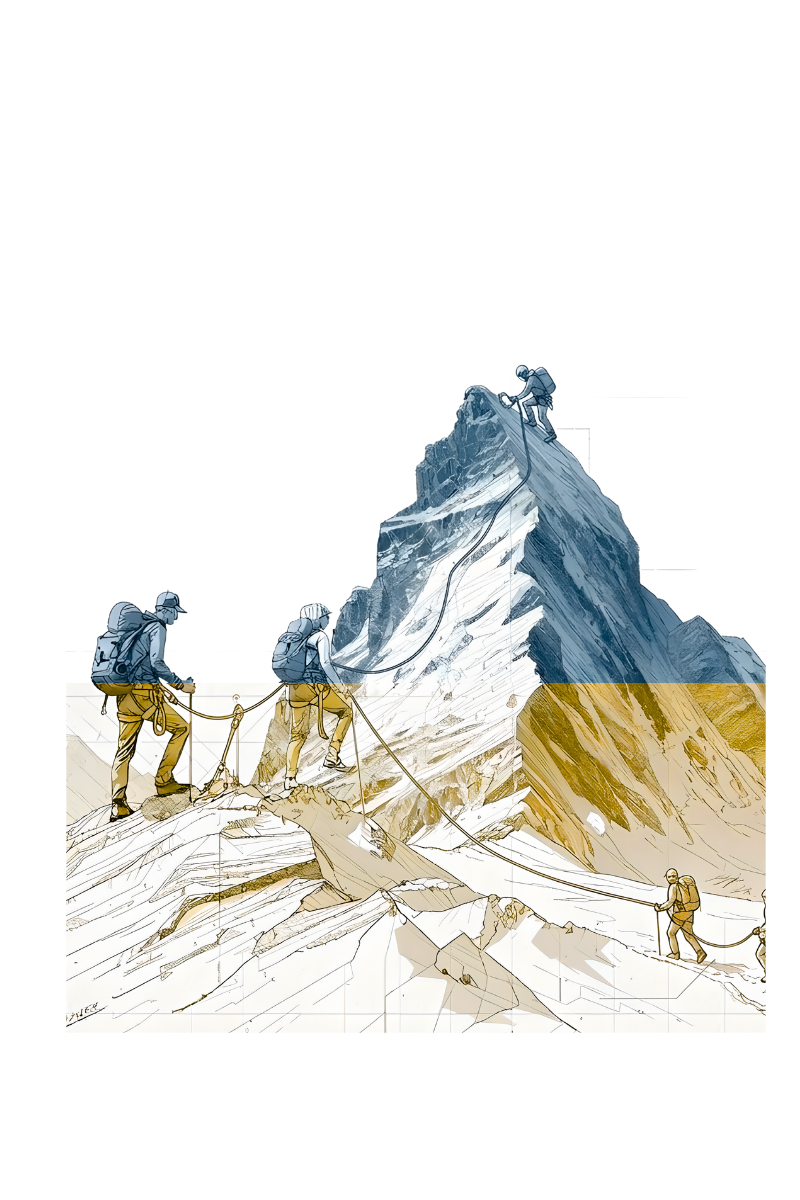
At EmmerScale, we help growth-stage founders, franchisors, and operators self-implement EOS® with precision. We understand that your time is your most valuable asset, and mastering a new operating system doesn’t happen overnight. We don’t just hand you a framework. Our Fractional Integrators clip into the rope with you—helping your team build the cadence, close the gaps, and execute with the discipline that real scaling demands.
Ready to stop guessing and start scaling? If you're a growth-stage founder, franchisor, or operator looking to implement EOS® with precision, let's talk. We don't just consult; we climb with you.
Schedule a call to see how our Fractional Integrators can help you reach your summit.
“EOS is is a registered trademark of EOS Worldwide. EmmerScale is not affiliated with EOS, and is not a certified EOS implementor, nor does it represent itself as such. EmmerScale works as a fractional integrator/ business consultant with its clients to utilize the permitted network of EOS self-implementation model. Please visit eosworldwide.com for information regarding certified EOS implementation.