
-1.png?width=332&height=79&name=Untitled%20design%20(17)-1.png "Untitled design (17)-1")

You proved the concept. Candidates are signing. New territories are opening quarterly. This was supposed to be the exciting part of building a franchise, and instead your corporate team is scrambling to keep up with the growth you spent years earning.
That gap follows a pattern. Franchise systems tend to break in the same places between five and fifty units, and they break in a predictable order. Below are seven signs that a franchise network has outgrown its operational infrastructure, what each one is costing you, and what it looks like once it is fixed.
EmmerScale helps growing companies and franchise networks that are scaling faster than their operations can handle - by building the people, process, and platform infrastructure that lets them grow without the chaos.
The seven warning signs at a glance
Emerging franchisors watching their first twenty to fifty locations come online tend to hit these seven in roughly this order:
- Franchise sales outpace your support infrastructure. You are selling units faster than you can support them.
- Franchisee performance varies more than your playbook can explain. Similar markets, same system, different results.
- Onboarding depends on you. New owners cannot launch without the founder in the room.
- Support requests overwhelm your team. The same questions arrive daily with no system or process in place to absorb them.
- Decision debt is accumulating. Recurring issues get discussed and never permanently closed.
- Your platforms do not talk to each other. Data lives in disconnected systems with no single source of truth.
- Growth feels harder, not easier. Each new location adds complexity instead of efficiency.
These patterns come out of hands-on work inside franchise systems in that unit window, not from survey data. Each one is diagnosable, and each one traces back to a specific gap in People, Process, or Platforms.
1. Your franchise sales are outpacing your support infrastructure
How do you know franchise sales have outrun your support systems?
When new owners arrive expecting documented systems and find "tribal knowledge" instead, sales velocity has passed support capacity. The signal is not slowing growth - it is a corporate team working evenings to answer questions that should already have answers, and satisfaction drifting down while unit count climbs. The fix is building the operational layer that ideally should be in place before the signings start.
Your franchisees signed on for documented systems, training programs, and playbooks. What they found was institutional knowledge living in a few people's heads, different answers depending on who they asked, and support staff stretched past capacity.
The enthusiasm that came with the agreement fades fast when the first month of ownership feels improvised.
Warning indicators
- The support your franchisees expected at signing is not fully documented yet
- New owners wait weeks for training materials
- Corporate team members work evenings and weekends to keep pace
- Franchisee satisfaction is drifting down while unit count climbs
What it looks like fixed: A new owner onboards through a documented system, and your team spends its week building instead of firefighting.
2. Franchisee performance varies more than your playbook can explain
What does wide performance variance across franchise locations mean?
Performance variance usually signals that operational standards leave room for interpretation. When two owners open the same year in similar markets, follow the same system, and land in very different places, the gap sits between your vision and the documentation that was supposed to carry it. Closing it means turning the winning formula into playbooks specific enough that interpretation is not required.
Your strongest location and your weakest opened the same year. Both serve comparable markets. Both followed your system as they understood it. Something broke between what you built and what they executed.
Owners are not failing your system on purpose. They are filling gaps in it with their own judgment, and judgment scatters.
Warning indicators
- Customer reviews mention inconsistent service quality across locations
- Some owners have installed unofficial improvements to your system
- Field visits reveal different interpretations of the same brand standard
- Training effectiveness depends on who delivers it
- Your best operators cannot articulate what they do differently
What it looks like fixed: Your median performer starts to look like your top performer, and you can point to exactly why.
3. Your onboarding process depends on you.
What is founder dependency in a franchise system?
Founder dependency means new units cannot open and existing owners cannot get answers without the founder personally involved. It is the most common growth ceiling in the five-to-fifty-unit window, and it is a documentation problem rather than a work-ethic problem. The fix is moving what lives in your head into playbooks, training libraries, and a corporate team with the authority to answer.
Scaling now requires cloning you, and no amount of effort pushes through that wall. As hard as you try, your personal capacity has become the bottleneck for the entire system.
Warning indicators
- Franchisees text you directly instead of using support channels
- Decisions stall while waiting for your input
- You have not taken a real vacation in over a year
- Your leadership team cannot answer franchisee questions without checking with you
What it looks like fixed: Documented processes take you off the frontline, and your team answers the question the same way you would.
4. Support requests overwhelm your corporate team
What does high franchisee support volume actually indicate?
Repetitive support tickets are a documentation problem wearing a staffing costume. When owners cannot find an answer, they open a ticket; your team answers manually; nothing permanent gets built. Self-service infrastructure - a searchable knowledge base, a video training library, clear escalation paths - resolves the question before it reaches a person.
Your support inbox fills faster than your team can empty it. The same questions arrive daily from different owners.
Your most capable people spend their week answering repeat inquiries instead of building the systems that would end them.
Warning indicators
- Response times to franchisee requests stretch past two days
- Your team answers the same question several times a week
- No searchable knowledge base exists for owners
- Training materials live in scattered documents and email threads
- New support hires need months before they are useful
What it looks like fixed: Common questions resolve without a human, and your support team works on the exceptions. Hours aren't wasted and your team can truly spend their hours on efficient work.
5. Decision debt is piling up faster than you clear it.
What is decision debt in a franchise system?
"Decision debt" is the accumulation of recurring operational questions that get discussed but never permanently resolved. Every open item adds interpretation risk to the network, and over time those items compound into confusion that slows the whole system down.
Unresolved questions pile up. Issues get talked through in leadership meetings and never receive a final answer. Your franchisees wait for clarity while the same debate reopens next month.
If you are running on EOS®, this is the pattern where the same Issues keep landing back on the L10™ agenda and Rocks slip quarter after quarter. Vision is not the problem.
Clearing it takes escalation paths, approval workflows, and documentation standards that close an issue for good.
Warning indicators
- The same topics appear on leadership agendas month after month
- Owners get different answers depending on who they ask
- Policy clarifications sit in progress for quarters
- Ad hoc decisions create precedents that contradict other ad hoc decisions
What it looks like fixed: A question gets answered once, documented, and never returns to your agenda.
6. Your technology platforms do not talk to each other.
What is "Gear Bloat"™ and how do you know you have it?
Gear Bloat™ is the accumulated cost and friction of redundant, underused, and disconnected platforms. It shows up as a software bill growing faster than capability, weekly reports assembled by hand, and KPIs calculated differently depending on which system produced them. A platform audit surfaces both the recoverable monthly cost and the integration gaps creating the manual work.
Your CRM does not sync with your franchise management system. Marketing data sits in one platform and sales data in another. Your team exports spreadsheets to build reports that should generate themselves.
When information has to be assembled by hand, decisions get made on incomplete context. Your franchisees are living the same problem one level down.
Warning indicators
- Weekly reporting means exporting and combining data manually
- Franchisee KPIs are calculated differently across locations
- No single dashboard shows network-wide performance
- Most of your IT tickets are integration problems
What it looks like fixed: One source of truth, synced platforms, automated reporting, and a team that stops reconciling spreadsheets.
7. Each new location is harder than the last.
Why does opening new franchise locations get harder instead of easier?
Franchise operations should get more efficient with each unit as fixed investment spreads across more locations and repeatable playbooks speed up launches. When effort per unit climbs instead, the growth is being absorbed by people rather than infrastructure. That is what makes a fiftieth opening harder than a twentieth instead of easier.
Your tenth location took more out of you than your fifth. Your twentieth took more than your tenth. The operational load per unit keeps climbing when it should be falling.
Scale is producing complexity where it should be producing efficiency.
Warning indicators
- Time from signing to launch stretches with each new owner
- Corporate headcount grows faster than unit count
- Problems solved at one location resurface at another
- Cost per opening has climbed over the past two years
- Long-tenured owners say things used to run better
What it is costing you: Margin compression, corporate burnout, and a ceiling you will hit at a unit count you can probably already name.
What it looks like fixed: Your fiftieth opening is easier than your twentieth, and the numbers show it.
______________________________________________________________________________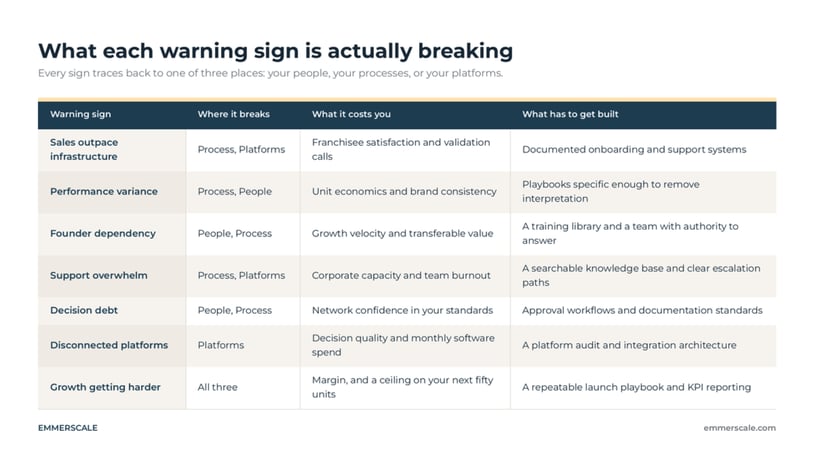
Outcome: Once you know which dimension is breaking, the sequence of fixes stops being guesswork.
What causes these warning signs in emerging franchisors?
All seven share a root cause: the strategies that built your early success were not designed for what comes next. What worked at five locations breaks at twenty. What worked with hands-on founder involvement fails once documented systems have to carry the weight.
Emerging franchisors outgrow their infrastructure in a predictable order. First you prove the concept. Then you sell franchises. Then you build the systems that let the network scale. Most founders are strong through the first two stages. The third calls for different skills and dedicated capacity that the existing team rarely has room for.
How does operational infrastructure affect what your franchise business is worth?
A buyer is not paying for your revenue. They are paying for revenue that keeps arriving after you leave. Documented systems, a leadership team with real authority, and clean data in one place are what make earnings look transferable in diligence instead of dependent on the founder. Every sign above is a discount waiting to surface in a term sheet.
The seven warning signs are also the seven things a buyer's diligence team will find. Founder dependency is the one they price hardest, because it is the clearest signal that what they are buying may not survive the handoff.
Performance variance is next, since wide gaps across the network make forward projections difficult to defend. Disconnected platforms slow diligence itself and put a question mark next to every number you present.
You do not need to be selling next year for this to matter. The work that makes a franchise system easier to run is the same work that makes it easier to value, and it takes time to show up in the record a buyer will actually review.
The infrastructure that carries you through your next fifty units is the same infrastructure that determines what the business is worth when you decide to hand it over.
When should an emerging franchisor bring in operational support?
The best time is before the signs get acute. Building systems proactively costs less and disrupts less than recovering from a crisis, and three or more signs showing at once means the compounding has already started. Each month of delay widens performance variance, deepens founder dependency, and adds to decision debt.
Start by finding out which sign is your "Oxygen Leak" - the one gap that will choke growth before any other improvement matters. That is what a structured diagnostic is for.
Outcome: you stop guessing at what is broken and start moving in the right order.
What scaling without chaos actually looks like.
✔️Franchisees performing closer to your top operators.
✔️Systems that transfer cleanly to every new owner.
✔️A corporate team building instead of firefighting.
✔️Senior execution capacity in the functions that need it, without full-time overhead in every seat.
You are still on the climb. The difference is a rope team clipped in and infrastructure that holds the weight of your growth.
Consider our complimentary S.C.A.L.E™ Readiness Assessment and see your business holistically from 30,000 ft. →
Explore our Franchise Services